
1. Why study Management?
While business school is often ridiculed for being less difficult than subjects like engineering, learning how to manage and lead people towards a goal is a valuable skill - especially as information and technical skills become increasingly democratised.
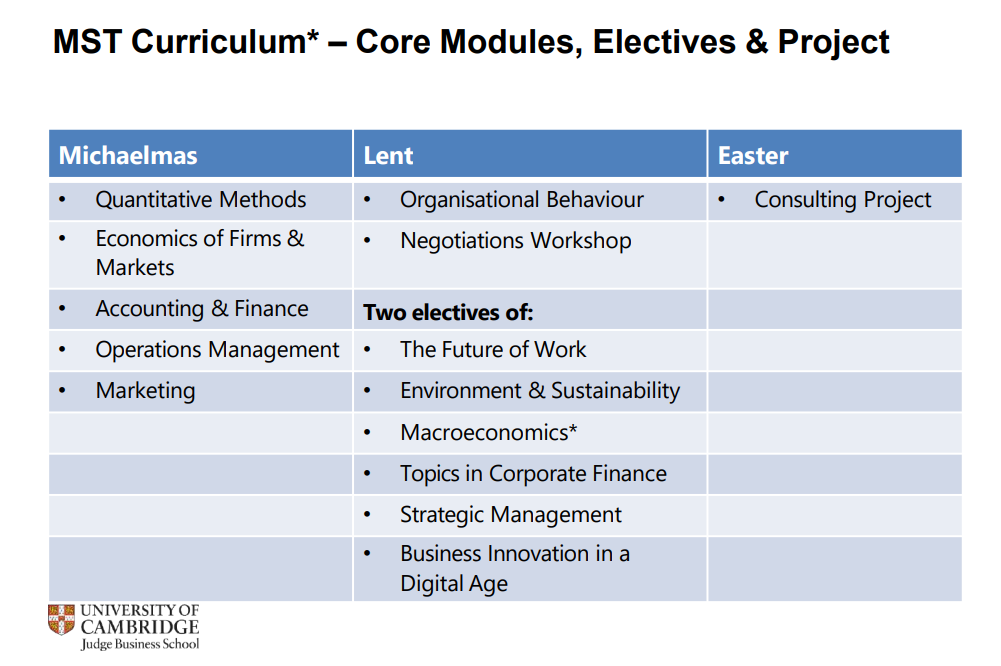
Management Studies Tripos (MST) is largely geared towards management consulting (e.g. McKinsey). It gives you a sense of what working in that space is actually like. Rather than just memorising content as medicine often entails, it offers practical parts as well (e.g. negotiation workshops, consulting project with a real company).
If you haven’t already, it’s worth reading the MST Annual Information document to understand the course structure. I won’t repeat that here - instead, I’ll focus on the key reasons why this course can be useful.
2. Pros and Cons of the MST course
Pros:
- Builds another skill on top of medicine. This can be useful much later on for managerial roles, but even in the short term it gives you a different perspective that adds to how you see things.
- Quite relaxed workload compared to most STEM subjects, which gives you time to focus on other things - job applications (for non-medics), exploring more of Cambridge (societies, colleges), or just having more free time.
- The architecture and environment at JBS feel more inspiring (e.g. compared to the physiology building). It was designed to encourage more creative thinking, with open spaces, diagonal staircases, and more colour - it does subtly change how you feel day-to-day.
- The JBS ecosystem feels more friendly and collaborative than many scientific environments, probably because it leans more towards networking. Conversations with the MBAs can be much more fascinating than with undergrads - they’ve often already graduated and spent time in industry, so you learn a lot just from talking to them.
- The JBS is more connected to innovation and entrepreneurship groups externally (e.g. Kings Elab) or internally (e.g. Accelerate Cambridge). The network effect is more important than academic credentials, the JBS is a top 10 business school in the world, so choosing this course means you likely won’t need to go to business school later on.
Cons:
- It can start to feel a bit meaningless after a few months (e.g. spending a lot of time making PowerPoint slides), though this might partly be because medicine sets quite a high bar for seeing tangible impact.
- If a non-medic taking it in your 4th year, can incur an additional 9k tuition costs (or higher if an international).
- Sometimes it can feel more of a tick-box course to show you went to business school for humanities students to boomerang into consulting.
A few logistical points:
- For non-medics, it’s generally best to do it in 3rd year (rather than 4th), as you can still graduate with both degrees without adding an extra year (and another 9k in tuition costs).
- One of the most competitive courses for entry (>68% threshold). Paradoxically, while the course itself can feel easier, getting a first can actually be harder because you’re competing with people who already achieved firsts in their original subjects. This matters more if you’re in 3rd year (70% of your Tripos), but much less in 4th year (does not contribute to tripos). However since the grade does not contribute to the 4th years’ tripos, some of them might not work as hard.
- The end-of-April deadline for colleges to submit applicants is strict - if you’re unsure it’s still worth applying anyway (you just need to speak to your DoS), as you can always withdraw later if you change your mind.
Hope this helps!